You don’t have time for yoga.
That’s what you think, anyway. Your schedule is packed. Your stress is high. Your sleep is poor. The last thing you have is 60 minutes to drive to a yoga studio.
But what if you could transform your nervous system, reduce your stress, and improve your sleep in 15 minutes?
Not through meditation apps with soothing voices. Not through aspirational Instagram yoga sequences. But through a real, evidence-based routine that you can do in your bedroom, before work, or before bed.
This is the routine that actually works because it’s designed around how your body actually functions—not around what looks good in photos.
Why 15 Minutes Actually Works
The prevailing belief is that yoga needs to be long to be effective. 60 minutes. 90 minutes. Longer practices for deeper benefits.
This is partially true, but also misleading.
Research shows that even 12-15 minutes of daily yoga produces measurable benefits in nervous system regulation, stress reduction, and sleep quality. The key word: daily.
Fifteen minutes of consistent daily practice beats 120 minutes once a week.
Your nervous system doesn’t care about duration as much as it cares about signal consistency. When you practice the same calming routine every day at the same time, your body learns to expect it. Your nervous system starts preparing for calm before you even begin. By the time you start your practice, your body is already shifting into parasympathetic activation.
This is why this particular sequence works: it’s short enough to be sustainable (you’ll actually do it daily), and it’s structured to signal deep calm to your nervous system (so it works despite the brevity).
The Science of Sequence
This routine isn’t random poses strung together.
It’s built on specific principles:
Movement before stillness: You begin with gentle movement, not lying down. Your nervous system needs a transition from “alert and active” (your normal daytime state) to “calm and receptive” (your practice state). Starting with movement creates this transition.
Large muscle groups first: You engage your largest muscles (legs, back, core) first because movement of large muscles is powerful for nervous system regulation. This is more effective than focusing on small muscle groups.
Breath integration throughout: Rather than separating breathing from poses (breathing happens separately), this routine integrates conscious breathing into every movement. This is more effective than breathwork done in isolation.
Meditation at the end: You finish with stillness and meditation only after your nervous system has been prepared and primed.
Trying to meditate without physical and breathing preparation is like trying to sleep without dimming lights—possible, but working against your natural physiology.
Consistency markers: Certain poses repeat to help your nervous system recognize the pattern. Familiarity creates deeper nervous system signals.
This is the structure taught in many yoga teacher training programs, refined for maximum effectiveness in minimum time.
The 15-Minute Routine
Time: 15 minutes total When: Morning for energy, evening for sleep, or between work meetings for stress relief Equipment: Yoga mat (optional—a carpet works fine) Space: Enough room to extend your arms and legs
Minute 0-1: Seated Centering (1 minute)
Sit comfortably on the floor or a chair. Feet grounded.
Close your eyes. Take three deep breaths—inhale through your nose for 4 counts, exhale through your mouth for 4 counts.
On the third exhale, set an intention: “I release what I cannot control. I trust my body to find calm.”
Why this works: This signals to your nervous system that you’re beginning a practice. Intention-setting activates the prefrontal cortex, preparing your brain for regulation.
Minute 1-3: Cat-Cow Stretch (2 minutes)
On your hands and knees.
Inhale: Drop your belly, lift your chest and gaze slightly upward (Cow pose). Feel your spine lengthening.
Exhale: Round your spine, drop your chin to your chest (Cat pose). Feel your spine flexing.
Repeat this breath-to-movement cycle 8-10 times, moving slowly and deliberately.
Go at the pace of your breath, not at any external tempo.
Why this works: This mobilizes your entire spine, warming up your nervous system. The alternating extension and flexion is deeply calming. The breath-to-movement integration teaches your nervous system to coordinate movement with breathing.
Minute 3-5: Thread the Needle Stretch (2 minutes)

From hands and knees, thread your right arm under your left, gently rotating your torso.
Your right shoulder and ear rest on the ground or mat.
Breathe here for 4-5 breaths, letting the gentle twist release tension.
Switch sides: thread your left arm under your right.
Why this works: This stretch targets the thoracic spine and releases spinal rotation. The gentle twist massages your organs and stimulates parasympathetic activation. This pose is particularly effective for releasing shoulder and upper back tension—where most people hold stress.
Minute 5-7: Forward Fold (2 minutes)
From hands and knees, press back into Child’s Pose (sitting on your heels, forehead resting on the ground or mat).
Let your arms extend forward, or rest them alongside your body.
Breathe deeply here. Don’t try to stretch deeper. Just rest.
Stay for 8-10 breaths, allowing your entire back body to release.
Why this works: Child’s Pose is one of the most calming yoga poses because it signals safety to your nervous system (folded position, forward-folded spine). This is a foundational pose in all yoga teacher training in Rishikesh programs because of its profound nervous system effects.
Minute 7-9: Supported Bridge Pose (2 minutes)
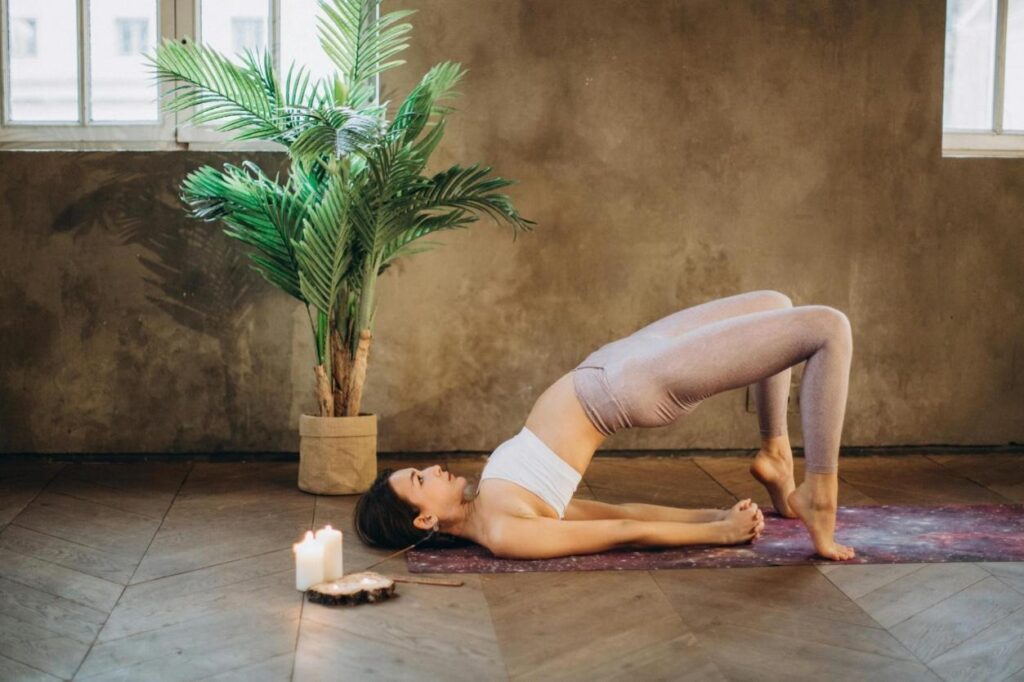
Lie on your back, knees bent, feet flat on the floor, hip-width apart.
Press your feet into the ground, lift your hips toward the ceiling.
Hold for 5 breaths. Lower down.
Repeat 5-6 times, lifting and lowering with your breath.
Why this works: Bridge pose activates your core and posterior chain, energizing your body slightly. This is important because you’re preparing to transition to stillness—a small energy boost prevents your mind from wandering during meditation. The repeated lifts and lowers create a rhythm that helps nervous system regulation.
Minute 9-12: Final Relaxation Pose (Savasana) – 3 minutes
Lie flat on your back, legs extended, arms at your sides with palms facing up.
Your feet fall naturally open. Your head is in neutral position.
Close your eyes. Let your entire body relax completely into the floor.
Scan through your body mentally: Release your forehead. Release your jaw. Release your shoulders. Release your arms. Release your belly. Release your legs.
Breathe naturally (not controlled). Just notice your breath.
Why this works: This is where your body integrates all the benefits of the movement. Your nervous system, now thoroughly prepared by the previous movements, drops into deep parasympathetic activation. Your body releases tension. Your mind begins to settle.
Minute 12-15: Brief Meditation (3 minutes)
In Savasana position, shift your awareness to your breath.
For 3 minutes, do nothing but notice your breath. Don’t control it. Don’t change it. Just observe it.
When your mind wanders (it will), gently notice that your mind has wandered, and return attention to your breath. No judgment. This is what meditation is.
If thoughts arise, imagine them like clouds passing through the sky—you notice them, but you don’t grab onto them.
After 3 minutes, slowly open your eyes.
Why this works: This brief meditation isn’t meant to bring you to some transcendent state. It’s meant to give your brain experience with non-doing. After the movement prepares your nervous system, stillness allows it to integrate the calm.
Regular practitioners find this final meditation grows deeper over weeks and months of practice.
For those interested in deepening meditation practice beyond this brief introduction, there are many 200 hour yoga teacher training in India that not only teach meditation but also in-depth yoga classes that progressively helps longer practices and more advanced techniques.
Making This Part of Your Life
The routine is only valuable if you actually do it.
Here’s how to make it stick:
Same time daily: Choose a time (morning before breakfast, evening before bed, midday break) and do it then every day. Your body will begin to expect this time and prepare for calm.
Same place: Use the same room or space. Your nervous system will begin associating this location with calm.
Before anything else: Don’t check your phone. Don’t think about your to-do list. Practice first, life second.
Track it: Keep a simple calendar. Mark off each day you practice. This builds momentum.
Feel the effects: Notice how you sleep better on nights you practice. Notice how your stress feels lower. Notice how your body feels. These observations motivate continued practice.
Integration with Deeper Practice
This 15-minute routine is complete and effective on its own.
But many practitioners find that after 2-4 weeks of consistent practice, they want to go deeper. They want longer practices. They want to understand the philosophy behind the poses. They want guidance on progressing safely.
This is where structured training becomes valuable. Working with qualified teachers—particularly those trained in comprehensive yoga teacher training programs accelerates your progress and deepens your understanding.
Teachers trained in proper yoga instruction can assess your individual needs, correct your form, and guide you toward practices matched to your specific goals (sleep improvement, stress relief, flexibility, strength, etc.).
Many practitioners who begin with a simple 15-minute routine eventually seek out more structured guidance from certified instructors. The journey of practice often naturally deepens.
Why This Works When Other Routines Don’t
Many beginners try yoga once or twice and never return. Not because yoga doesn’t work, but because they’re doing routines not designed for beginners.
This routine works because:
It’s short enough to actually do: No excuses about time. 15 minutes fits in anyone’s schedule.
It’s effective enough to feel benefits: Within one week, you’ll notice improved sleep and reduced stress.
It’s sustainable: You won’t get bored of a 15-minute routine. You won’t strain yourself. You won’t quit from frustration.
It’s scientifically structured: Each element serves a purpose. Nothing is random.It builds momentum: Early benefits motivate continued practice. Continued practice creates deeper benefits.
